


Outdoor Digital Signage in 2026: Why Brightness, Durability and Connectivity Are Non-Negotiable
Outdoor digital signage deployments are growing fast across the UK and France. Here's what decision-makers need to know about high brightness, vandal resistance and 4G/5G connectivity.
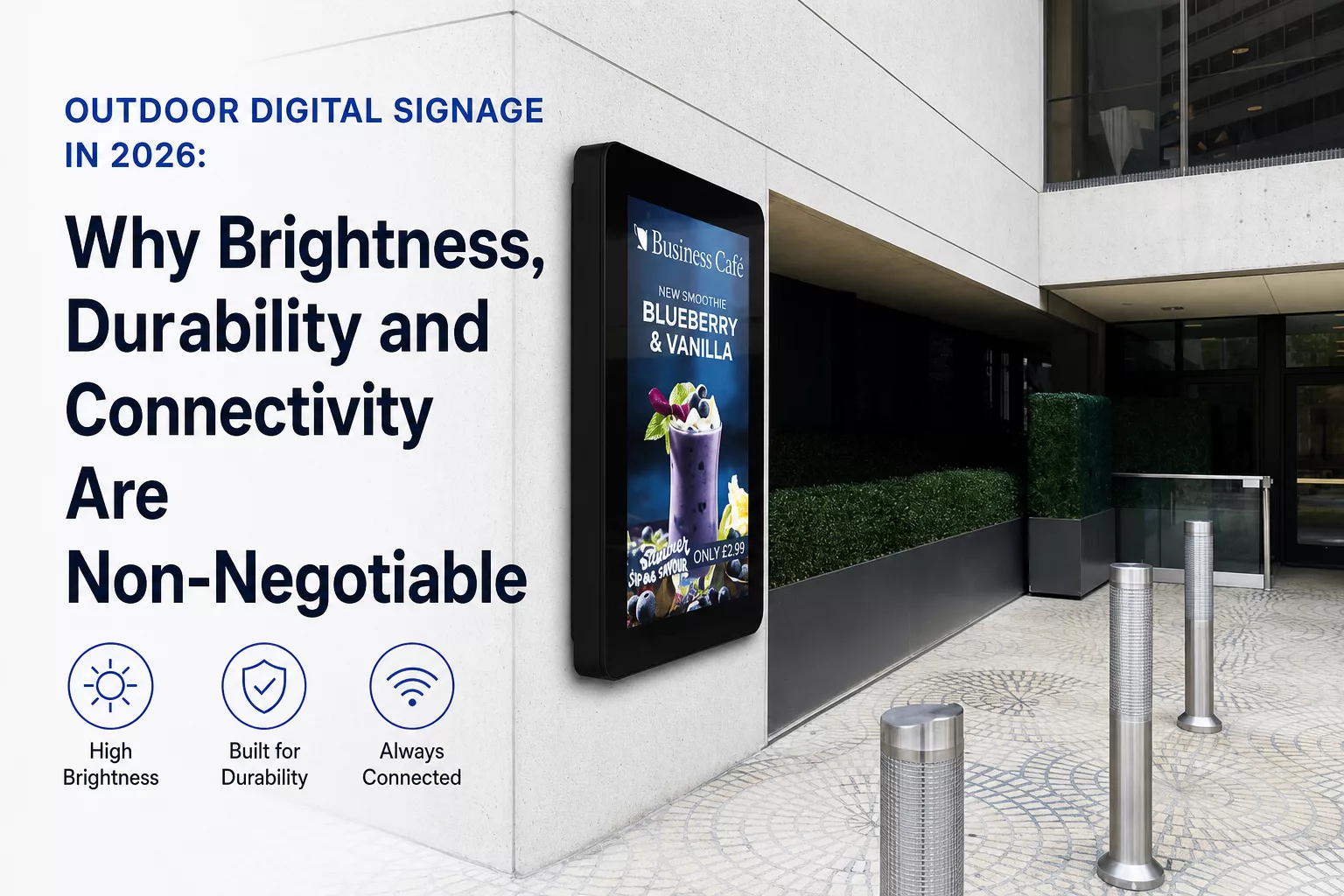
The Shift to Outdoor Digital Signage
Businesses are increasingly moving their digital communications beyond the four walls of a building. From transport hubs and retail forecourts to stadium entrances and smart city installations, outdoor digital signage is no longer a novelty — it is a core part of how organisations communicate with customers, staff and the public.
But deploying screens outdoors introduces a set of challenges that simply do not exist indoors. Sunlight, weather, physical interference and unreliable connectivity can all cause expensive failures if the wrong hardware is chosen. Understanding what separates fit-for-purpose outdoor signage from an indoor screen bolted to a wall is essential before committing to a deployment.
High Brightness: The First Thing to Get Right
Indoor commercial displays typically operate at around 300 to 500 nits of brightness. Step outside on a bright summer day, and that figure becomes effectively invisible. Outdoor digital signage requires significantly higher brightness levels — commonly 2,500 nits or above — to remain legible in direct sunlight.
This is not simply about turning up a dial. High-brightness panels require additional thermal management, because pushing luminance generates considerable heat. Purpose-built outdoor enclosures incorporate ventilation, fans or even active cooling systems to prevent premature failure. Buyers should always verify that a display has been tested for sustained outdoor operation, not just peak brightness in controlled conditions.
Vandal Resistance and Physical Durability
Outdoor environments expose hardware to risks that go well beyond weather. Public-facing screens in particular must withstand physical impact, attempted tampering and, in some locations, outright vandalism.
Key durability standards to look for include:
- IP65 or higher ingress protection — ensuring the enclosure is fully dust-tight and resistant to water jets from any direction
- IK10 impact resistance rating — the highest classification under EN 62262, indicating the display can withstand significant mechanical impact
- Toughened glass or polycarbonate front panels — providing a physical barrier against scratching, cracking and forced entry attempts
- Robust mounting and anti-tamper fixings — preventing opportunistic removal or repositioning of the unit
Skimping on any of these areas in the name of cost savings tends to result in far greater expenditure on repairs, replacements and downtime over the lifetime of a deployment.
Connectivity: Why 4G and 5G Change the Game
Traditional digital signage relied entirely on a wired Ethernet connection back to a server or content management system. For many outdoor locations — car parks, temporary event sites, remote retail points — running a dedicated Ethernet cable is impractical or prohibitively expensive.
Modern outdoor signage solutions should support multiple connectivity options simultaneously:
- Ethernet for permanent, high-bandwidth installations where cabling is feasible
- Wi-Fi for locations within range of an existing wireless infrastructure
- 4G/5G cellular for remote or mobile deployments where fixed connectivity is unavailable
The inclusion of 4G and 5G connectivity in particular is transformative. Content can be updated in real time, diagnostic data can be transmitted remotely, and installations can go live in locations that would previously have been impractical. For businesses operating across multiple sites — including across the UK and France — cellular-connected signage dramatically simplifies network management.
Choosing the Right Hardware Partner
Outdoor digital signage is a significant infrastructure investment. Choosing hardware that meets the environmental, physical and connectivity demands of the deployment from day one avoids costly retrofitting or early replacement cycles.
At BOSH Group Ltd, we work with businesses across the UK and France to specify commercial-grade display and signage hardware that is genuinely fit for purpose. If you are planning an outdoor signage deployment and want straightforward, expert guidance on the right specification, get in touch with our team.